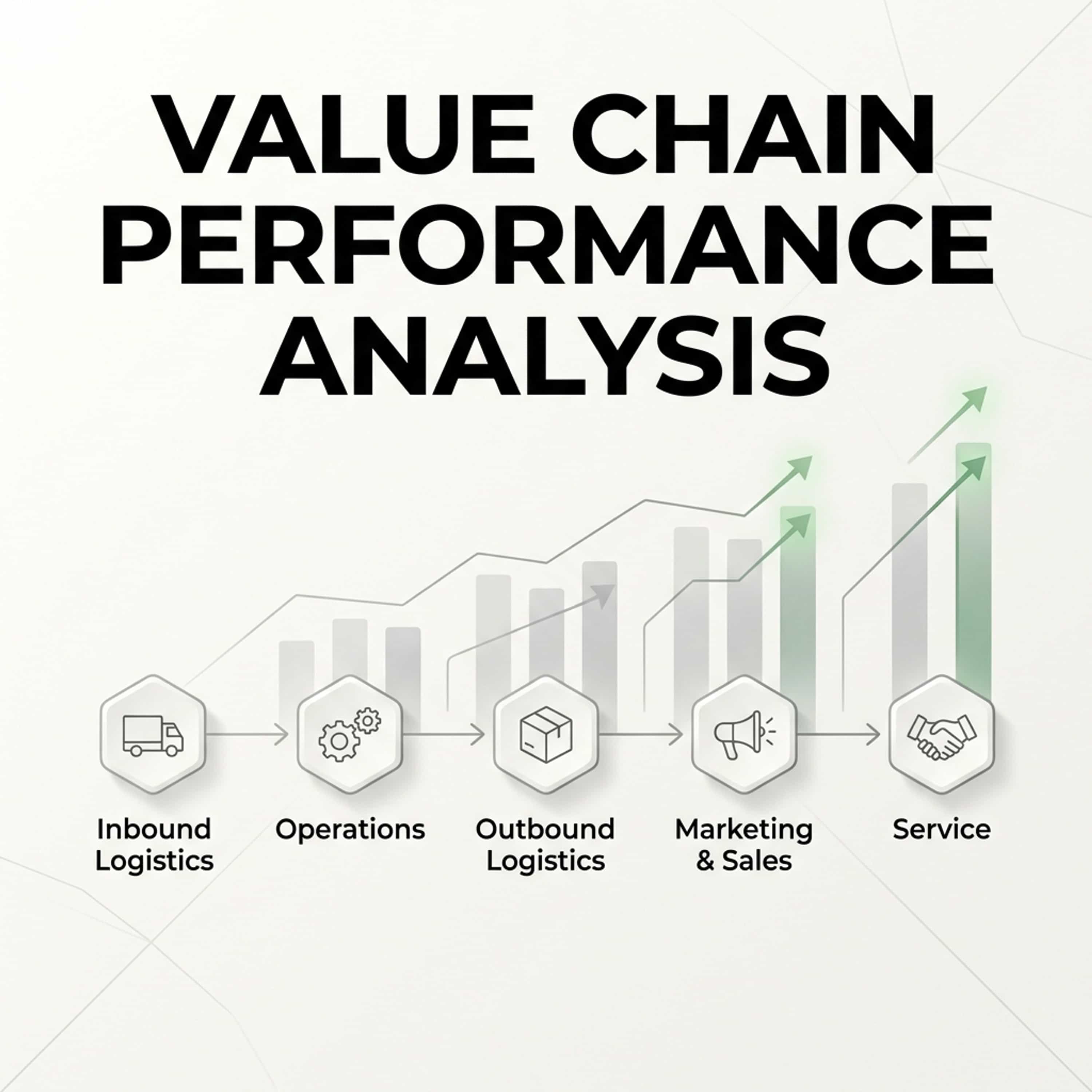
Porter’s Value Chain: From Coca-Cola to Netflix
Explore Michael Porter’s value chain framework and how it reveals where organizations create or lose value across primary and support activities. The episode compares real-world examples from Coca-Cola Kenya and Netflix while unpacking cost leadership, differentiation, and the role of AI in modern operations.
Is this your podcast and want to remove this banner? Click here.
Chapter 1
The Anatomy of Value: Demystifying the Value Chain Model
Dr. Linda Nelms
Welcome everyone! I'm Dr. Linda Nelms. Today, I want to start with a picture that really drives home what we mean when we talk about operations. Imagine a delivery truck navigating the bustling, sometimes unpredictable traffic on a road just outside Nairobi, loaded with crates of sparkling cold beverage bottles. Now, why are we starting there? Because that single truck represents a massive strategic puzzle.
Dr. Linda Nelms
In operations management, we often look at how organizations survive and thrive. And back in 1985, a Harvard Business School professor named Michael Porter introduced a framework that completely changed the game: the value chain. Now, many people confuse value chain analysis with basic process mapping. But here is the critical distinction: process mapping is about making a workflow run smoother. Value chain analysis, on the other hand, evaluates how every single activity actually builds your market position and profitability. It's about finding where value is created, and where it's being lost.
Dr. Linda Nelms
Porter split these activities into two groups: five primary activities and four support activities. The primary ones are the heavy lifters that directly handle the product. We have inbound logistics, which is receiving and warehousing raw materials. Then operations, transforming those materials. Next is outbound logistics, distributing the finished product. Followed by marketing and sales, and finally, after-sales service.
Dr. Linda Nelms
But those primary drivers can't run in a vacuum. They are enabled by the four support activities: procurement, technological development, human resource management, and firm infrastructure -- which is your finance, legal, and planning. When I helped manage various supply chains, I quickly learned that improving a support activity, like procurement, almost always has a direct, positive ripple effect on your primary activities.
Dr. Linda Nelms
Let's look at a concrete example. A qualitative case study on Coca-Cola in Kenya highlighted that despite their incredible market presence, they still faced latent inefficiencies. The researchers pointed out that in the beverage industry, distribution is the literal "core of life" for success. When Coca-Cola Kenya analyzed their value chain, they had to look closely at primary activities like outbound logistics.
Dr. Linda Nelms
They identified real distribution-linked challenges: inventory overstocks and stockouts caused by forecasting errors, transport delays, and even quality control risks. By systematically analyzing these touchpoints, managers could target specific areas for resource allocation rather than just making blind, across-the-board budget cuts.
Dr. Linda Nelms
Now, contrast that physical, heavy-logistics setup with a digital powerhouse like Netflix. The Strategy Institute recently broke down how Netflix's value chain operates entirely in a virtual environment. Think about this: their inbound logistics isn't warehousing syrup and bottles; it's licensing content rights and building partnerships. Their operations are their massive proprietary media production studio sets and post-production technology.
Dr. Linda Nelms
And their outbound logistics? It's global streaming delivered via cloud infrastructure -- specifically, Amazon Web Services. Their marketing and sales rely heavily on data analytics to feed you personalized recommendations. It's a completely different structure, yet the underlying strategic logic of Porter's model fits them just as perfectly as it fits Coca-Cola.
Chapter 2
Strategizing for Excellence: Cost Leadership vs. Differentiation
Dr. Linda Nelms
This brings us to the core strategic choice every operations leader must make. Porter argued there are two main paths to competitive advantage: cost leadership or differentiation. If you choose cost leadership, your goal is to be the lowest-cost producer in your industry while maintaining acceptable quality. You're tracking metrics like manufacturing cost per unit or operating expense ratios.
Dr. Linda Nelms
If you choose differentiation, you are investing heavily in research, product design, and customer experience to make your offering uniquely valuable, allowing you to charge a premium. Netflix actually did a bit of both as they evolved, using data analytics to optimize their content spend while introducing lower-priced, ad-supported tiers to maintain their massive market share.
Dr. Linda Nelms
Historically, doing this kind of analysis was a massive, static undertaking. It usually took three to six months of manual data collection, resulting in a report that sat on a shelf until the next annual planning cycle. But today? AI and automation are turning value chain analysis into a continuous, real-time loop.
Dr. Linda Nelms
We now have digital work platforms, Enterprise Resource Planning Systems (ERPs), and machine learning that pull automated data directly from the shop floor or customer service queues. Instead of waiting for a quarterly review, predictive analytics can flag shipping delays, notice an anomaly in defect rates, or suggest inventory adjustments before a stockout even happens. This is operational visibility at its finest.
Dr. Linda Nelms
I love a quote from one of the Coca-Cola managers in the Kenyan study. They said, "Value Chain Analysis is not just numbers on a page. It is the insight that reshapes how we function." Another executive called it the "pulse of our strategy." When done right, it helps every single employee see where they fit. An assembly worker or a delivery driver realizes their role isn't just a isolated job -- it's a vital link in the broader chain of success.
Dr. Linda Nelms
Of course, implementing this isn't without its hurdles. You need rigorous data accuracy, and you have to navigate the change management required to turn these insights into actual, on-the-ground action.
Dr. Linda Nelms
As you move forward in your studies, I encourage you to look at the value chain not just as an academic framework, but as a practical roadmap for organizational excellence. Dive into your course resources, explore how these operational concepts apply to different industries such as Health Care, Retail, Human Resources and Transportation, and think about how you can use these tools to build stronger, more sustainable systems. Keep exploring, keep questioning, and remember to check out the other Podcasts linked in the course resources!